Saturday, September 3, 2011

A Monstrous Success!

It's always gratifying to hear about a Café Roxy series finding an audience that likes the programs and builds from week to week. That's the way it is supposed to work, but I don't often get feedback unless the customer wants more. Such was the case this week in a phone call from one of the programmers at the Hollywood Theater in Dormant, PA.

The Hollywood Theatre, one of two theatres in the Pittsburgh suburb of Dormont, stood closed and shuttered in 1998 after screening Paul Newman and Susan Sarandon in “Twilight”. After nine years it re-opened on 30th March 2007 with “Night at the Museum” and “Dreamgirls”.

For many years in the 1950’s and 1960’s the Hollywood Theatre, with its seating capacity of 980, was one of Stanley Warner’s main second-run neighborhood houses in Pittsburgh, and even enjoyed a spell as a first-run house in the late 1960’s. Later on, Associated Theatres bought S-W’s holdings in the area, which were then sold to Cinema World. The Hollywood Theatre was closed on May 25, 2008.

On June 27, 2009, the Hollywood Theatre reopened for monthly classic movies. Motion Picture Heritage are the new operators.  Their successful programming mixes the old and the new.  Some films shown in August were The Perfect Host with David Hyde Pierce, Beat the Devil, Lee Van Cleef in Day of Anger, To Catch a Thief and Munster Go Home!


The Café Roxy success they reported on was for our "12 Nights of Horror" series, which has been running every Wednesday night for $7 admission.  It seems they added a few wrinkles. When they showed "The House on Haunted Hill" they flew a skeleton over the audience.  That's what William Castle told theaters to do back in 1959, but who has done it since?

Then a few days ago they showed "The Brain That Wouldn't Die" and recreated the head and lab setting onstage.  Whenever the head appeared in the movie, a spotlight came up on the body-less actress.  I forgot to ask if she spoke the lines in the movie.  It's gimmicks like this that will garner local publicity and larger crowds.


The Hollywood plans to run horror all through October and plans to include our "Turkeys in Space" series of sci-fi clunkers.  This week they ordered the 2-hour "Monster Mania" collection of classic trailers and spooky cartoons and the 1950s Space TV program from Matinee series #2.

I included a free DVD of the just finished "Spoooky Stuff" Volume 1.  This is a refinement of Monster Mania that includes excerpts from features, anything spoooky like a scene from the 1926 The Bat.  The one-hour of clips is followed by the "Thriller" TV show "The Return of Andrew Bentley."  This show is not yet on my website, but is finished.  On to Volume 2!

I suggested that the Hollywood re-create a "Spook Show" onstage for Halloween itself with a magician act and running "Monsters Crash the Pajama Party" where the gorilla and other monsters come off the screen into the audience to select a girl victim.  They liked that idea and may use a rising horror host on Pittsburgh TV, Mr. Schlock.  Sounds like a team-up born in Hell.

It's never too early to plan on a Spoooky Halloween.  (Adding the extra "o" makes it 3 times spoookier!"

Visit my spoooky website at Festival Films.

Saturday, August 27, 2011

No Holiday Too Small!

I started the week looking for some 10 second video horror clips to turn into introductions for "Spooky Stuff!"  Why I am stuck on that silly title, I really don't know.  The idea is to make short sequences from horror movies and trailers for Movie Memories and another project still in development.  I found some perfect bits I had forgotten I had.  These were movie trailers for special horror shows on Friday the 13th (how else could you turn it into a holiday) and of course Halloween.

The film titles are not given so theaters could use the same trailers year after year.  Since all the films were revivals from years before, the specific titles did not matter much.  More important, and lest we forget, is the "suggestion" to "Bring your date and have a party...!"  What better opportunity ever presented itself for necking and making out in the dark.  You can watch two of these trailers that run 50 and 32 seconds in the video below and then see how I turned them into "Spooky Stuff" intros, or I should say "Spooooky Stuff!" since the word is spookier with extra "o's" in there.

This got me remembering newspaper ads in the 1950s for horror revivals I would have killed to have seen as a kid.  Never got to any.  We had no movie theater in Deerfield, Wisconsin and excursions to Madison were rare and NEVER for any midnight show.  I never even asked since I wasn't allowed to see horror films on TV or stay up late.  In 1962 we moved to Madison and I could go to movies on my own, but not at midnight.  I recall an all-afternoon quadruple feature that included "It Conquered the World" and I have no idea what else.  I did attend one live Spook Show when I was in high school and wrote about it HERE.  I also went to all the Edgar Allen Poe Vincent Price films, Ray Harryhausen films, etc.

I just looked for some of these ads on the Internet and could not find much at all.  If anyone knows of a website showing thousands of movie newspaper ads, please let me know.  You sure had a choice on this one Halloween in Appleton!  3 Theatres!  9 Horror Hits!

A further re-watching of my forgotten video reminded me that movie theaters used any Holiday as an opportunity to celebrate it with them -- Father's Day, Mother's Day, a Valentine's Day cartoon matinee, New Year's Eve and even New Year's Eve Matinee.  I put some of these brief trailers into the video below.  Amazingly, one is for a series of Roy Rogers matinees at the Majestic Theatre in Madison, Wisconsin, where I did watch movies in the 1960s, but was not around when the trailer advertised them in the 1940s.  Kids could get free tickets from a bank; all the theater wanted was their concession money.  I bet the place was packed week after week.


Visit my website at Festival Films

Saturday, August 20, 2011

Tarzan Escapes - Bat Bait

"Bat Bait" refers to advertising a movie scene with giant bats.  I would watch a film just to see Tarzan fight bats.  Wouldn't you?

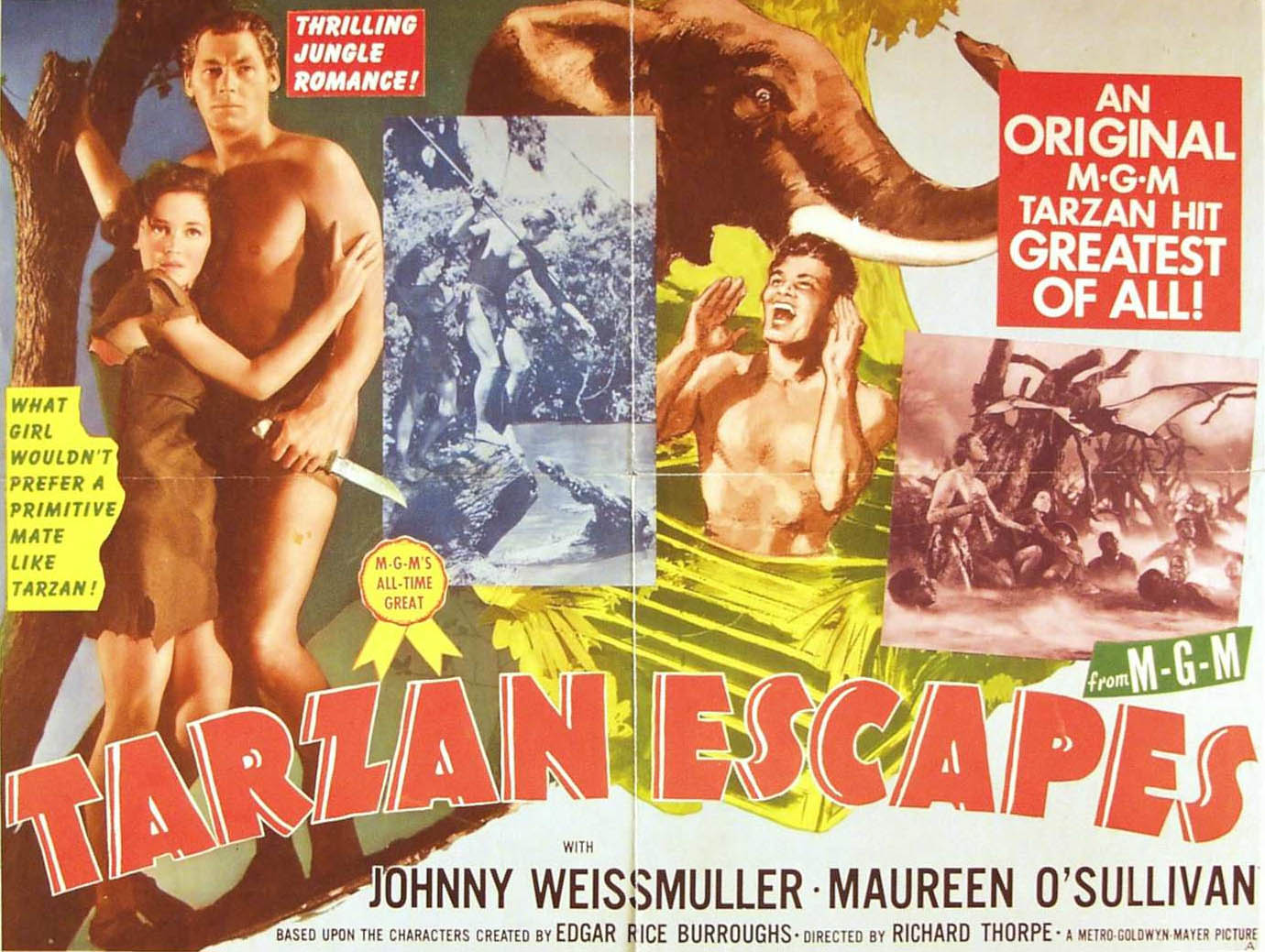
To summarize past posts, in 1954 at the age of eight I saw the national reissue of Tarzan Escapes in a movie theater. In the intense and scary climax the safari enters a ju-ju cave where they are attacked by giant vampire bats.  I never forgot but I have never seen this lost horror sequence again.  I have been on a six year quest collecting info and trying to alert people to look for the lost footage, which may well survive in prints of the film residing in foreign archives.  Most foreign posters from both 1936 and 1954 mention the bats, so the prints must have had the elusive scene.  If you hold such a print deep in a Mexican or Italian vault, look at the last ten minutes of it!

The half-sheet movie poster shown here is from this 1954 reissue, and is the only USA poster that shows the bat scene.  It was up for auction at emovie-poster.com this past week.  I bid $90 but lost out to $99.  I might have bid more except I forgot about the deadline!  A few years ago I missed out on the same poster that I believe sold in the $190 range.  The owner of the highly reputable and long-standing auction house emovieposter.com is Bruce Hershenson.  I got Bruce interested in the lost film aspect such that he discusses it like this whenever a Tarzan Escapes item is up for auction:

Tarzan Escapes, the 1936 Richard Thorpe & William A. Wellman African jungle adventure fantasy horror action thriller ("It's NEW! It's AMAZING 2 years to produce"; the second sequel to the hugely successful "Tarzan the Ape Man"; "Based upon the characters created by Edgar Rice Burroughs") starring Johnny Weissmuller (in the title role as Tarzan; the 1924 Olympic swimming champion who is best remembered for playing Jungle Jim and for his role in this series), Maureen O'Sullivan (as Jane), John Buckler, Benita Hume, William Henry, and Cheeta (the chimpanzee). 

Note that I thought that I knew a lot about early Tarzan movies, but it turned out I did not know any of the important facts about this movie! Unknown to me, the movie was actually filmed in 1935, and there is a major subplot involving Tarzan, pygmies, and vampire bats, basically making it a horror film! The studio hated the movie, and hired a new director to re-film it in 1936, and they junked all of the 1935 movie EXCEPT for the major vampire bat scene in the cave at the end, and they made drastic changes to the plot (added the tree house home, no great apes, no Jane rescuing Tarzan at the end, etc)! The 1936 version was previewed and mothers complained that the movie was too violent and scary for their kids, so the sanitized version that exists on video today was released to some 1936 theaters. However in 1954, when the movie was re-released, MGM used the uncut negative with the vampire bats. Sadly, when the film was made available to TV and for 16mm rental in the 1960s, MGM again used the censored negative, so there is now no complete print of the 1936 "director's cut" (and of course, the 1935 version is lost as well). But this is just a summary. You should read the collector's entire blog on this at http://caferoxy.blogspot.com/2010/10/still-batty-about-tarzan-escapes.html

It's an accurate summation of my researh.  Thanks, Bruce.  So what is new with my search?

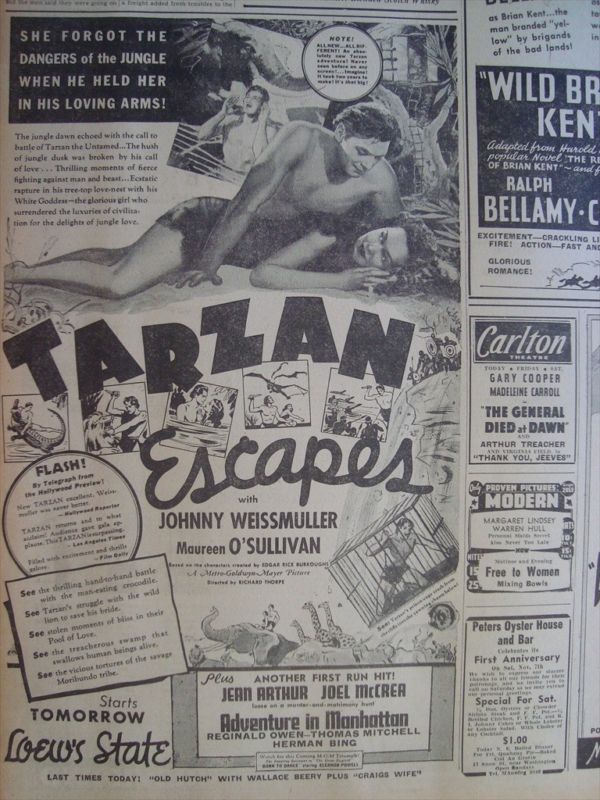
I occasionally check Tarzan Escapes items on ebay and was surprised to find two original newspaper ads.  I could "Buy It Now for $25 each" but capturing the images onto my computer suits me just fine.  Both are included in this post.

They advertise showings at Loew's State Theater in Providence, RI starting Nov. 6, 1936.  Both ads have tiny images of the bat attack.  This is further proof that the un-cut bat prints were widely shown in the original 1936 release, along with the censored prints elsewhere.  Tarzan had never fought giant bats before or since.  No movie depicts such a scene.  Bats were a big draw and distinguished the film from other Tarzan films.  I assume that no theater could advertise vampire bats and then show a film without any bats.  Audiences would have gone wild.

Emovieposter.com has a helpful feature whereby one can sign up to get notices of any auction items on your favorite film.  This alerted me a few weeks ago to the auction of a "Herald" for Tarzan Escapes, which I did bid on and get for under $20.  A herald is a promotional insert that newspapers can include if a movie theater pays for them.  MGM sent out sample heralds in their publicity kit, which this was, as opposed to one actually distributed in a newspaper.  It makes more sense that such a fragile piece might survive for years in a pile of press books, etc., from some movie theater than that some fan would save one from a 1936 newspaper.

"This Space Reserved for Theatre Imprint" on the back cover of the 4-pager includes an order blank to order the things from Post Publishing in Appleton, Wisconsin, with the theater playdate info, at a cost of $3.50 per thousand.  It points out: "This tabloid on TARZAN ESCAPES will bring many extra dollars to your office."

Note that the cover has a large picture of Tarzan and Jane in a tree fending off lions.  This scene does not exist, but was part of the lost 1935 version of the film!  A brief shot from the cut and lost "dozens of lions" scene does show up in the opening montage right after the credits of other Weismuller Tarzan films like Tarzan's New York Adventure.  Look fast for the lions next time you watch this one!

The inside two-page, newspaper-size spread also mentions the bat battle in tiny print: "See! See! The giant vulture bats swoop from the sky in a vicious air attack!"

Lastly, I ran across this clip on Youtube from the excellent TCM documentary about the MGM Tarzan films.  Maureen O'Sullivan discusses filming the dreadfully uncomfortable swamp/bat scene.  She concludes that the scene was cut from the film.  Not true!  I saw it and hope to again.


Visit my website at Festival Films

Saturday, August 13, 2011

Farewell to the Bouncing Ball!

I have learned so much about Screen Songs in the last 3 weeks that I have written another blog article about it for the Bijou Blog and am considering starting a new website. This entry may be short, as I will send you to the other blog down below.

Paramount made 5 Screen Song color cartoons before they were called that. Then from 1947 to 1951 they made 38 in the Screen Song series that opened with this title card and music (although that Paramount Mountain is incorrect). In 1951 the series name suddenly changed to Kartune Musical Shorts producing 12 under that banner through 1953, then two late entries again called Noveltoon:


Candy Cabaret, 1954, was directed by Dave Tendlar who had animated Betty Boop and Screen Songs for Fleischer from 1932, and ranks among the most charming Screen Songs.  A sugar cube leads the orchestra in a night club where the patrons, band and dancers are all pieces of candy.  The girl singer is a cute candy heart, and the catchy song "Ain't She Sweet" is a real crowd pleaser.  You can enjoy it HERE.  

Then out of the blue nine years later (1963) came Hobo's Holiday, directed by Seymour Knietel, an equally experienced animator who worked on the first Popeye cartoon in 1933.  The animation is "limited" like the Popeye, Casper and Beetle Bailey TV cartoons that Kneitel also directed.  The single gag involves a hobo stealing a fresh pie from a bulldog.  "Big Rock Candy Mountain," about a paradise for hobos, is fun to sing but many audiences may have gaped in silence, not knowing they were supposed to unite in song after so many years.  Let's say kids might have been in the dark; adults had long memories and still join in on sing-alongs at select revival showings today.  The tradition of the hobo hopping on words that turn into animated images remained.  You can pay a fond farewell to the Bouncing Ball HERE.


I put a few Screen Songs and Kartunes on Youtube and found there is a fan following.  This gave me the idea that a website devoted entirely to Screen Songs might be useful to fans.  I could send out an SOS looking for original 16mm and 35mm prints, from which better video transfers might be made.  I could list them all and post a link to the best quality versions currently on Youtube.  One goal would be to find all of them.  The 1948 color Screen Song "Readin', Writin' and Rhythmetic'" seems to be missing at the moment even though it is in the public domain, and there must be many of the 108 Max Fleischer sound ones currently unavailable for viewing.  Any encouragement out there?

Take a look at Time on My Hands from 1932.  Ethel Merman sings the title song, but the main attraction is a comely but topless Betty Boop (voiced by Mae Questel) as a mermaid.  Also the first color Paramount in the Screen Song series -- The Circus Comes to Clown.  Then one of the Kartune series from 1951: Fresh Yeggs with the theme of animals in prison.

To read more from me about Screen Songs, plus a list of the 12 Kartune Musical Shorts, please visit The Bijou Blog. I have been associated with the Bijou folks for the last 6 or 7 years. Among many active projects, we are trying to bring back the hit 1980s PBS series "Matinee at the Bijou" in new episodes in Hi-Def or in DVD releases of the original series only with the complete features re-mastered. We hope to announce concrete plans soon! 

Visit my website at Festival Films

Saturday, August 6, 2011

Sing Me a Thousand Screen Songs!

Everyone uses Wikipedia as a quick source of information. Everyone should know they don't know everything. It says so right on the site. Thus last week I wrote there were around 40 color Screen Songs made by Paramount from 1945 to 1951, which is true, except this week I found more of them.  The history of Screen Songs at Wikipedia is well written:

The Screen Songs are a continuation of the earlier Fleischer series Song Car-Tunes. They are sing-along shorts featuring the famous "bouncing ball", a sort of precursor to modern karaoke videos. They often featured popular melodies of the day. The early Song Car-Tunes were among the earliest sound films, produced two years before The Jazz Singer. They were largely unknown at the time because their release was limited to the chain of 36 theaters operated by The Red Seal Pictures Company, which was equipped with the early Lee DeForest Phonofilm sound reproduction equipment. The Red Seal theater chain -- formed by the Fleischers, DeForest, Edwin Miles Fadiman, and Hugo Riesenfeld -- went from the East Coast to Columbus, Ohio.


Between May 1924 and September 1927, the Fleischers released 36 Song Car-Tunes series, with 17 using the Phonofilm sound-on-film process. The films included Oh Mabel, Come Take a Trip in My Airship, Darling Nelly Gray, Has Anybody Here Seen Kelly?, and By the Light of the Silvery Moon. Beginning with My Old Kentucky Home (1926), the cartoons featured the "follow the bouncing ball" gimmick, that lead the audience singing along with the film. The Fleischers were ahead of the sound revolution, and just missed the actual change when The Red Seal Company filed for bankruptcy in mid-1927.


The Fleischers signed a new contract with Paramount Pictures in late 1928. Beginning in February 1929, the song cartoons returned under a new name, Screen Songs, using the Western Electric sound-on-film process. The first was The Sidewalks of New York (East Side, West Side) released on 5 February 1929. In the 1930s, the shorts began to feature such musical guest stars as Lillian Roth, Ethel Merman, Cab Calloway, Rudy Vallee, the Mills Brothers, the Boswell Sisters, and others. The series, which eventually focused on many of the "big bands" of "The Swing Era" continued until 1938.


In 1945, Famous Studios, successors to the Fleischers, revived the Screen Songs as an all animated series in color. The earliest color Screen Song part of the Noveltoon series, "When G.I. Johnny Comes Home Again." was released on February 2, 1945.
*****

The Wikipedia entry goes on to list all of the Fleischers and the 38 color cartoons that were in the official "Screen Songs" series from 1947 to 1951. The title screen as shown up above and the opening credits all include the catchy tune:

"Start the day with a song, and sing the whole day through.
Even while you're busy working, do just like the birdies do.
Though the day may be long, you never will go wrong.
Off key, on key, any old key, just start the day with a song!"

However, several Bouncing Ball sing-alongs appeared in the Noveltoon series before the SS series started: "When G.I. Johnny Comes Home Again" (1945),  "Old MacDonald Had a Farm" (1945), "The Goal Rush" (1946), "Madhattan Island" (1947, with two songs "Penthouse Serenade" and "42nd Street") and "The Mild West" (1947).  All five are in the public domain.  I have the fascinating "Madhattan Island," but the current quality is too poor to do anything with it.

Last week I borrowed a nearly complete collection of Paramount cartoons from 1943 to 1967, minus the Popeyes and George Pal Puppetoons, but with Little Lulus, Little Audreys, Caspers, Buzzy Crows, Herman and Catnips, etc.  Some were poor quality, a few were black and white and some had great color.  Many were transferred from the 16mm prints distributed by U.M. and M and NTA TV in the 1950s and 60s.  I really don't know where this massive library came from.  (Before I forget, the images in this blog came from Jerry Beck's superb Cartoon Research site.)

I had wondered why the popular Screen Songs ended suddenly in 1951.  Turns out they didn't!  The series stopped, but Paramount kept making them through 1954, except the cartoons fell back into the Noveltoons series.  Did audiences start going to the concession stand if a cartoon song came on, but stayed to watch a normal cartoon?  It is impossible to tell in the first half if the Bouncing Ball will make an appearance.  I can't list all of these "extra" Song Cartoons because you can't tell from the titles listed in Len Maltin's "Of Mice and Magic" (1980) and I could not view one of the discs due to damage. These 1953 cartoons include Screen Songs: "Philharmaniacs," "Aero-Nutics," and "Invention Convention" where the audience can sing "Let Me Call You Sweetheart."

Right here and now you can enjoy "Candy Cabaret" from 1954, which just might be the last Paramount Screen Song ever made!  Sing along at home to "Ain't She Sweet!"


Visit my website at Festival Films

Saturday, July 30, 2011

Sing-Along With Screen Songs!

Audience Sing-Alongs to words projected on a screen go back before 1900 using magic lanterns.  The famous "Bouncing Ball" debuted in 1924 in the Max Fleischer "Ko-Ko Song Car-Tune."  The first song was "Oh Mabel."  A superb discussion is in this Nov. 2007 entry in the  Bijou Blog (that I may have helped write, not sure).  Fleischer made many sing-along cartoons in the silent era with a seamless transition into the sound era  up through 1938.

In 1945, Famous Studios, successors to the Fleischers, revived the Screen Songs as an all-animated series in color. The earliest color Screen Song was part of the Noveltoon series -- "When G.I. Johnny Comes Home Again" -- and was released on February 2, 1945.  This series produced around 40 cartoons thru 1951.  Both the Fleischer and Paramount sound ones are listed by title at Wikipedia."

Audiences singing out loud and together in a movie theater was tremendously popular, which may be hard to believe by anyone who did not share the experience.  The words appeared onscreen as the Bouncing Ball bobbed from one word to the next so the audience was never in doubt just what to sing, in case they were not familiar with the song.  Over 25 of the color ones are in public domain and I include them in volumes of Movie Memories.  Seniors sang along way back then in theaters in the 1930s and 40s and they sing along today.

Although the cartoons are clearly in the public domain, some of the songs are still copyrighted.  In most cases you can use films (with © music) as public domain without paying royalties to the owner of the music.  The theory goes that the music was paid for when the film was made and when the entire entity goes into public domain, then you can show, sell, broadcast or use the complete film anyway you want.  If you take an excerpt out of a film to use in a documentary, then you need to separately clear rights to any music involved.  Most TV stations still have an arrangement with ASCAP that allows them to show any films without clearing music rights.  I don't know what rules might apply for using public domain films with music on the Internet.

The only time I recall being contacted about music was 30 years ago re. the score by Virgil Thomson on "The Plow That Broke the Plains" (1936).  I offered it for sale on 16mm at the time, which rarely sold.  I don't recall what I wrote back, but never heard from them again, not even when I began selling it on video and now DVD.  If I tried to sell this or any film with music to Turner Classic Movies, then I would certainly clear music rights if needed to be completely safe.

Today I am considering turning more of the color Screen Songs into Movie Memories for a situation that might request either song clearance or assurance that the song was also in the public domain.  The series used familiar standards so many of the songs were written before 1923.  This is the magic cut-off date for songs, films and books: all written before 1923 are public domain; most made in or after 1923 are copyrighted as long as they were properly renewed.  So here is a list of the Paramount Screen Songs that I have that are in the public domain along with the song included in each and the date it was written.


The Emerald Isle - "McNamara's Band" (1945)
Old MacDonald Had a Farm - Title Song, of course (1917?)
Sing or Swim - "By the Beautiful Sea" (?)
The Mild West - "I'm an Old Cowhand" (1936)
Base Brawl - "Take Me Out to the Ball Game" (1908)
Short-nin Bread - Title Song (1900)
The Big Flame-Up - "There'll Be a Hot Time in the Old Town Tonight" (1896)
Helter Swelter - "In the Good Old Summer Time" (1902)
Comin' Round the Mountain - Title Song (late 1800s)
The Lone Star State - "Deep in the Heart of Texas" (1941)
Marriage Wows - "For Me and My Gal" (1917)
Little Brown Jug - "Little Brown Jug" (1869)
The Golden State - "California Here I Come" (1921)
Winter Draws On - "I'm Alabama Bound" (1909)
Snow Foolin' - "Jingle Bells" (1857)
When G.I. Johnny Comes Home - "When Johnny Comes Marching Home Again" (1863)
Win, Place and Show Boat - "Waitin' for the Robert E. Lee" (1920)
Spring Song - Title Song (1894)
The Funshine State - "Tallahassee" (1947)
The Stork Market - "Pretty Baby" (1916)
Gobs of Fun - "Strike Up the Band" (1927)
The Big Drip - "It Ain't Gonna Rain No More" (1923)
Our Funny Finny Friends - "Three Little Fishies" (1939)
The Ski's the Limit - "Swiss Miss" (?)
Farm Foolery - "Shine On Harvest Moon" (c.1905)
Toys Will Be Toys - "Oh, You Beautiful Doll" (1911)

Well, that was interesting research. To Me!

Visit my website at Festival Films


Sunday, July 17, 2011

New (to me) tool for Researching Copyrights!

I check and re-check the copyrights on films all the time, certainly every week.  So it comes as a surprise that I have never blogged about the process before.  Oh, yeah, boring....  The process may be but the results are often fascinating. For one thing I found this past week that the 1958 Steve Reeves film HERCULES is in the public domain. Everyone else knew it but somehow I though it was copyrighted although I've been selling the sequel, Hercules Unchained, for years.  Now I can add the first film to my library.

Last week I got the notion that perhaps episodes of "The Howdy Doody Show" were indeed copyrighted although I had thought they were all public domain.  Some research did not turn up any registrations or renewals, and many episodes do not have the © notice with a date on them.

Actually I am not looking for copyrights, but for the lack of an original or renewal copyright.  For years I have used three rare and out of print books covering the years 1900 to 1939, 1940 to 1949, and 1950 to 1959.  They list all original registrations with the Library of Congress in alphabetical order for those years.  A typical short entry from the first volume is:

A BEDTIME STORY, Bluebird, 1926, 1 reel.
Credits: Director George Summerville. © Universal Pictures Corp.; 31Mar26; LP22565.

This is followed by the 1933 feature called "A Bedtime Story." The old rule was that each film needed to be renewed 28 years later, so the people compiling these books looked at renewal records 28 years later to see which films had been renewed (most were).  The 1926 one-reeler was not renewed and so there is no notation after the title and it is considered to be in the public domain.  The 1933 feature was renewed and so the book has the hand-written notation: R255994, 27Apr60.

This set of ten volumes is copyrighted 1973 by Walter E. Hurst.  Thank you, Walter!

All registrations and renewals from 1978 to the present are online at the Library of Congress Website.  There are perils navigating the thousands of entries.  Be aware that "Type of Work: Recorded Document" is not a © registration or renewal.  The 3 entries for Roy Rogers Show: "Ambush" are all Recorded Documents, meaning they are mentioned in some kind of document that was registered with LOC, but the TV episode itself is in the public domain.  You see, you could produce a show and sell it and re-sell it without ever actually copyrighting it.  You still owned it within the first 28 years, but by then a production company may have gone out of business and the film or series lapsed quietly into the public domain.  Hurray for our side!

In 1964 the copyright laws were changed such that any film or TV show made in that year or later could be registered AT ANY TIME and did not need to be renewed.  So some American movies made for TV in 1970 are sold as public domain today because they have never been registered with the Library of Congress.  However, at this late date, they still could be registered by someone who had some connection to making the films in the first place.  That's a little off my present subject, but films made in 1960 thru 1963 still needed to be renewed, and if they were not renewed 28 years later they are clearly and forever in the public domain.  There is a 1960s film copyright book to match the earlier volumes, but I never got one.

So I had a gap in the research I could conduct myself for films 1960 to 1977.  I just discovered a website with the Library of Congress records of registrations and renewals from 1950 thru 1978. You can peruse this website of The Hathi Trust Digital Library that scanned original LOC documents in University of Michigan collection.

Scroll down to one of the years, like 1961, and then down that page until you come to Motion Pictures. Under renewals you find listed Universal's "Air Mail," Paramount's "Blonde Venus," Columbia's "Bitter Tea of General Yen" and lots more films all from 1933 which were properly renewed 28 years later in 1961 and are still protected by current copyright law until 95 years after they were made.  We can see those three films today, but we may need to wait until 2028 before enjoying Universal's 1933 "Afraid to Talk," a film picked at random from the list that I have never heard of in my life.  The big question in 2028 will be if anyone has the film or if anyone wants to see it then!

Or you can click on New Registrations and will come to the page shown above.  A few pages later I found listings for "Adventures of Jim Bowie" shows that first aired in 1957 and 1958.  The Library of Congress used to require registration of feature films during the year a film was released or the next year.  However, they started accepting late registrations for TV shows, so late that some were registered 28 years from when they were made and were renewed at the same time.  Some episodes of Jim Bowie are public domain today, but most are copyrighted including the ones I just found.

Happy browsing!  Remember that NOT finding any listing or NOT finding any renewal 28 years later is the prize discovery that means the film or TV show may well be in the public domain.


Visit my website at Festival Films