Sunday, March 11, 2012

Rocketing Into the Future & Reliving the Past!

After no blog posts in January, and I am not sure why, I have put up comments that are hopefully of interest to some over the past five weeks. This week I had no inspiration until I found this poster for the 1939 World's Fair on Facebook. I just wanted to share the poster!  Our future may be brighter than the past and we can rocket into it quickly.  Just take off and there it is.  Optimism in 1939 ended in war in 1940.  But tomorrow is another day and here we are in 2012 when the Mayan calendar predicts the end of the 4th age of man, but not the end of the world, rather the start of a much brighter 5th age of man.  Ask me at the end of the year if we all blast off by then and where we might be going!

There are endless wonderful images on Facebook, I guess if you have the right "Friends" who post on similar interests.  I found this one posted by Matthew C. Hoffman, who is a Facebook friend who I don't really know.  He is running a Screen Deco film series in Park Ridge, Illinois.  Here is His Album of terrific stills and posters from art deco classics like She, Cleopatra, Madame Satan and Things to Come.

1939 has been heralded as Hollywood's finest year.  Memorable as they are, I would not pick Wizard of Oz or Gone With the Wind as my favorites today.  Here are some I do really like and will watch again and again whenever I find them on TCM: Stagecoach, Destry Rides Again, Gunga Din, Young Mr. Lincoln, Of Mice and Men, Hunchback of Notre Dame, Four Feathers, Drums Along the Mohawk and Man in the Iron Mask.  Outstanding serials of 1939 are Zorro's Fighting Legion, Daredevils of the Red Circle, Dick Tracy's G-Men and The Phantom Creeps.


*******

Drastically shifting topics, for some years I have sought out films that made an impression on me as a kid, say before the age of 14 or even younger.  I need to accept the fact that some movie memories may have never been filmed, they are dreams or false memories based on films I did see.  I did see the attack of the Giant Vulture Bats at the age of 8 in "Tarzan Escapes," since extensive research supports the memory, and I still hold out hope that this scene will someday be found.

Here is a memory I still have but can't find the scene in any film.  It is a jungle serial chapter ending that I saw on 1950s TV.  I recall the first chapter ending in a plane crash in the jungle, a very logical way to start a serial.  The ending of either chapter 2 or 3 is the one I can't find.  The hero and I am pretty sure the heroine with him are in a pit of crocodiles on a ledge just above all those snapping jaws.  In order to escape they need to make their way along the ledge to the other side where there is an escape door.  A stone slips and they appear to fall in the pit as the chapter ends.  I also thought this was a Clyde Beatty serial.  His 1934 Mascot serial The Lost Jungle ends with a dirigible crash in chapter one.  Chapter 4 is called "Pit of Crocodiles" but at the end he is dangling above the crocs hanging on for dear life -- no ledge or escape door.  There is no scene like I recall in his 1936 Republic serial Darkest Africa either.  I have looked through every other jungle serial I can find and no crocs-with-ledge scene.  I do have a few rare ones to someday acquire and look through, like Buster Crabbe's 1952 King of the Congo.  (Could I possibly have seen the lost Crabbe serial Tarzan the Fearless as a child?)

For Christmas I got myself the first two volumes of Floyd Gottfredson's collected Mickey Mouse newspaper comic strips. Floyd was the equal of Carl Barks in high adventure stories set in the old west, haunted houses, pirate islands or the Yukon. Comic fans must read these superb stories as they originally appeared in newspapers starting in 1929. The 1932-33 story "Blaggard Castle" involves Mickey and Horace Horsecollar vs. 3 mad scientists in a haunted castle. The setting either inspired the Mickey cartoon "The Mad Doctor" (1933) or was inspired by it since Floyd was aware of every Mickey cartoon in production. I suspect he saw the storyboard for the cartoon and turned the idea into the cartoon strip that ran about the same time the cartoon hit theaters.

In the comic strip, but not the cartoon, Mickey enters a crocodile pit and walks along a ledge, as shown in the few panels just below. Could I have seen a reprint of this strip as a child and transposed it to a jungle serial I saw on television??? I don't think so, but who knows?  I will keep looking.


Visit my website at Festival Films.

Saturday, March 3, 2012

NAPOLEON -- Silent Event of a Lifetime!

The film event of a lifetime happens this month just four times.  Four shows.  One magnificent setting in Oakland's Paramount Theater.  A Symphony orchestra.  Silent movie fans gathering from around the world.  Do not miss ... Abel Gance's Napoleon.  Complete information about the film, the theater and how to get tickets is at the San Francisco SILENT Film Festival website.  Here are a few notes from this site:

Abel Gance’s epic NAPOLEON is the Holy Grail of silent masterpieces. In the early 1980s, Francis Ford Coppola toured a 4-hour road show version that many still consider their most unforgettable movie experience ever. Now, over 30 years later, the San Francisco Silent Film Festival is finally presenting legendary film historian Kevin Brownlow’s complete 5 1/2 hour restoration in the United States, along with the American premiere of the magnificent score by Carl Davis, at the Art Deco Paramount Theatre, Oakland. Mr. Davis will conduct 48 members of the Oakland East Bay Symphony for these four unique screenings, which also feature the original “Polyvision” three-screen finale. Due to the expense, technical challenges, and complicated rights issues involved, no screenings are planned for any other American city. This monumental event is being presented by the San Francisco Silent Film Festival, in association with American Zoetrope, The Film Preserve, Photoplay Productions and BFI.

The list below is the top ten reasons why every cineaste must attend one of the four rare, never-to-be-repeated showings if at all possible  The list was compiled by Thomas Gladysz with a few additional notes by me in parentheses.

10) BACKGROUND: "Film historian Kevin Brownlow has spent much of his life piecing together this lost masterpiece which had been dismissed, neglected, cut up, reworked, and scattered by the winds of time."

9) KEVIN BROWNLOW: "In the March issue of Vanity Fair, Martin Scorsese wrote,  'If you love silent movies, Kevin Brownlow should be your hero.'"  (Mr. Brownlow will attend each screening.  A dinner gala can be attended on March 24 and he will give a lecture about his lifetime restoration of the film on March 30.)

8) SETTING: "Thanks in part to the Oakland Paramount - a temple to the motion picture experience - movie-goers who attend Napoleon may well find themselves spellbound in darkness."  (Numerous photos of the Paramount or on view at the website.)

7) MUSIC: "Carl Davis' score is a marathon and masterful work of film scoring which has twice been expanded to keep up with newly found footage."

6) CARL DAVIS: "Davis has written music for more than 100 television programs and feature films, but is best known for creating music to accompany silent films, including key Brownlow restorations."  (Carl Davis will conduct 48 members of the Oakland East Bay Symphony at each performance!)

5) BIGGER AND BETTER: "This current and likely final restoration, completed in 2000 but not previously seen outside Europe, reclaims more than 30 minutes of additional footage discovered since the earlier restorations while visually upgrading much of the film."

4) GREATEST FILM EVER MADE: "Here is what Vincent Canby had to say in 1981 in the pages of the New York Times. '...One suddenly realizes that there once was a film that justified all of the adjectives that have subsequently been debased by critics as well as advertising copywriters. Napoleon sweeps; it takes the breath away; it moves; it dazzles.'"

3) POLYVISION: "There are few movies so innovative, so daring and so hugely ambitious... For the finale, the screen expands to three times its normal width - a kind of triptych - while showing panoramic views and montages of images.  There really hasn't been anything else like it, not even Cinerama...  Prepare to be amazed."

2) VALUE: "For a five and a half hour movie (the length of three contemporary films) accompanied by a live symphony orchestra (a concert ticket too), the ticket prices to Napoleon are rather inexpensive."

1) EXPERIENCE: "In ten or twenty or thirty years, when this screening of Napoleon is only a memory, film lovers will ask - were you there? 'Did you see the Napoleon at the Paramount in 2012?'"

The lobby cards in this blog are very rare from an acquaintance who was looking to sell them some time ago.  I don't know what they are worth or whether they did sell, only that they are super rare.  The one at the top does NOT picture Napoleon or it would be worth a whole lot more.

Visit my website at Festival Films.

Saturday, February 25, 2012

"Silents Please" -- Life Changer!

The Oscars are tomorrow and the black-and-white, silent movie "The Artist" may well sweep the awards and even win Best Picture of the year.  I am not rooting for it to win since I haven't seen it yet.  I loved "Hugo" that is about the great pioneer of silent movies, Georges Melies.   Both have caused me to reflect back on my history with the Real Silent Movies made before 1929.  A fascination with them as a teenager truly set my life on the course that has led right up to today.

There were plenty of earlier movie influences on my childhood that made me want to see more. Foremost was being deprived of seeing many films. I have no memory of seeing anything before I was four, which is when the family moved from Texas to Wisconsin. Then I grew up in a small town that had no movie theater, but did have a series of free movies in the park every summer. I saw hardly any horror films before getting my first issue of "Famous Monster of Filmland" around 1961.

I devoured 1950s TV, saw my first mysteries, serials and cartoons there, Howdy Doody and the Mickey Mouse Club, Crusader Rabbit and later Rocky and Bullwinkle, all the TV western series and on and on. I also had good taste at times and one love was Ernie Kovacs. By coincidence or fate, in addition to his many TV specials, which often featured "silent" routines, Ernie also hosted the 1960-61 series called "Silents Please" that presented cut down versions of silent movies. The introduction and closing segments featured a quick shot of Lon Chaney as "The Phantom of the Opera" that particularly sparked my imagination several years before I was able to actually see the film.  So every week I tuned in Ernie and "Silents," said "Please" and hoped my best to see more of the Phantom.  As it turns out from this episode guide the show never ran "The Phantom of the Opera" even though it was in the public domain!  Ernie sadly died in 1962, and there was only one 39-episode season of "Silents Please."  In Madison about the same time we enjoyed a similar series "The Toy That Grew Up" out of the PBS station in Chicago.  I recall seeing Johnny Hines and Rod LaRoque half-hour abridgements.  Jay Ward's "Fractured Flickers" (1963) gave other tantalizing glimpses of Silents from Stan Laurel cavorting as Dr. Pyckle to the robot in Harry Houdini's "Master Mystery."

In college at University of Wisconsin, Madison (1964-1968) I attended a packed auditorium showing of "When Comedy Was King" in which the entire room convulsed with laughter for 75 minutes.  They also had occasional outdoor silent screenings of Laurel and Hardy shorts with live organ accompaniment. I met Harold Lloyd when he came to the campus testing his compilation film "The Funny Side of Life." It contained most of "The Freshman" (1925) and was a huge hit with the young audience. At the reception was pioneer producer and Wisconsin resident Harry Aitken, now in his mid-90s, who had co-founded Triangle Film Corporation in 1915 with his brother Roy. The most gracious Harold said, "You know, Mr. Aitken, I always wanted to meet you because I started my career working for your company but never got the chance until today."

Somehow I heard about Blackhawk films during this period and traded in some old 8mm cartoons for my first Laurel and Hardy 8mm -- "Leave 'Em Laughing."  This started my hobby as a film collector.  Then the Blackhawk bulletin one day mentioned a tiny publication for collectors called "The 8mm Collector."  Sam Rubin started the paper in 1962 to find silent movies to watch and also other collectors. I must have gotten my first issue in 1967 since I ordered a dozen or more of the early issues.  This led me to...

The Society for Cinephiles, Ltd, was established in 1965 by Tom Seller, an avid reader of The 8mm Collector magazine, and Cinecon 1 was sponsored by Samuel K. Rubin, publisher of The 8mm Collector, in Indiana, Pennsylvania. It was a small affair with only a handful of die hard film fans. They gathered in a small room at the local Holiday Inn and showed each other 8mm silent films from their personal collections. This was 1965 before videos and DVDs, a time when, if you wanted to see your favorite old film, you had to wait until it turned up on TV or else you had to buy a projector and start your own film collection in 8mm or 16mm.

The following year (1966) another cinephile, Clark Wilkinson, hosted the show in Baraboo WI and Cinecon officially became an annual event. For the next several years the Cinecon moved from city to city as a sort of moveable cinematic feast. Today, the fanzine 8mm Collector is known as the respected Classic Images magazine, and since 1990 Cinecon has made its home in the Los Angeles area.


Ironically, in 1966 I was a 20-year-old sophomore in Madison, Wisconsin, and Baraboo was less than an hour drive away.  I could easily have attended Cinecon 2.  I saw a newspaper article after it was over but did not know about the event in advance.  In fact Leonard Maltin flew there as a 17-year-old in high school.  I could also have attended Cinecon 3 in Chicago the next year but was unaware.  I did make it to Cinecon 4 in Hollywood over Labor Day in 1968, but that's a longer story.

Wanting to see as many silent films as possible, then to own them and finally to share them with others led to attending Cinecons from 1968 on, running the Xanadu Film Festival in Minneapolis 1971-1974, meeting my future wife Chris, making friends with film dealers, fans and collectors, and eventually starting Festival Films in 1976.  Meeting Chris, who came to the film society to make audio tapes of Marx Brothers films, stands above all else.  Chris also loved Ernie Kovacs, who perhaps set me on a course that brought us together ten years later.

Here is the opening to "Silents Please" that some of you my age may recall:


Visit my website at Festival Films.

Saturday, February 18, 2012

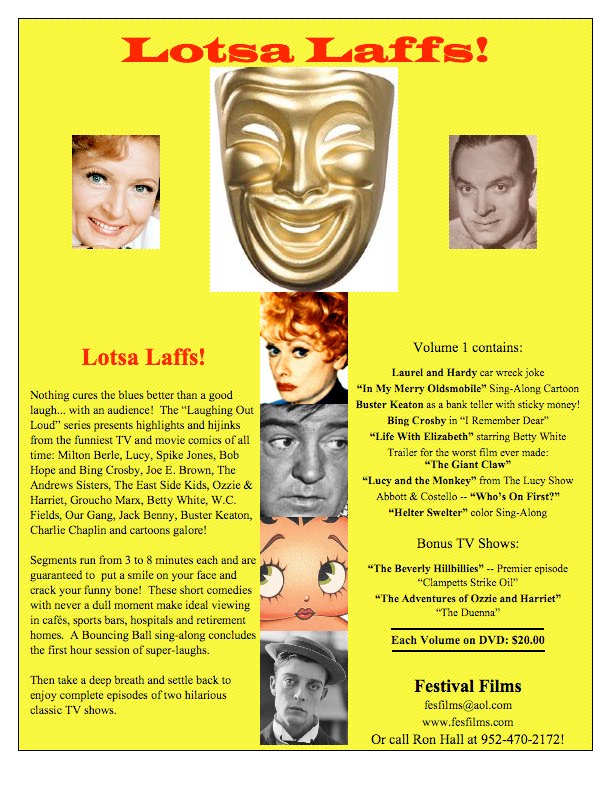
Lotsa Laffs! Lotsa Fun!

Last August I met with a local man who told me his father had recently died from cancer and the only thing that brought joy into his last days was laughing at classic comedy.  This gave the son the idea to create an online channel of streaming videos devoted to comedy.  That is a lofty goal but quite ambitious and I did not hear back from the man.  However, it gave me the idea to create a series of DVDs that were chock full of laughs, only the cream of the crop.  One projected audience was the retirement homes who prefer to watch films in one hour periods, but these would not be Movie Memories with discussion segments, only one comedy bit after another of the older films and TV shows which naturally are in the public domain.

To fill out the 2-hour DVD I would add two TV comedy episodes from shows like Beverly Hillbillies, Lucy Show, Love That Bob, Petticoat Junction, etc.

I at first called the series "Laughing Out Loud" and the first DVDs still use that name in the Introduction that is on the discs.  Then I found out Disney is about to release a feature called "Laughing Out Loud," plus of course "LOL" abbreviation one uses in emails has become an overused cliché.  So any word such on Google under Laughing Out Loud would never find my videos even if they became famous.  Ah, fame, how elusive you remain after all these years!  Anyway, an eventual name change to "Lotsa Laffs" and the funny way of spelling Laughs.  Perhaps this very blog entry will propel "Lotsa Laffs" into the Internet search engines.  Ah, fame!


"Nothing cures the blues better than a good laugh... with an audience! The “Lotsa Laffs!”series presents highlights and hijinks from the funniest TV and movie comics of all time: Milton Berle, Lucy, Spike Jones, Bob Hope and Bing Crosby, Joe E. Brown, The Andrews Sisters, The East Side Kids, Ozzie & Harriet, Groucho Marx, Betty White, W.C. Fields, Our Gang, Jack Benny, Buster Keaton, Charlie Chaplin and cartoons galore!"


"Lotsa Laffs! is perfect for cafés, sports bars, hospital laughing rooms, country clubs and retirement communities -- wherever and whenever folks need a hearty laugh out loud! 3 to 10 minute segments are guaranteed to put a smile on your face and a crack in your funny bone! A Bouncing Ball sing-along concludes each first hour session of non-stop laughs."

While "The Dentist" is a hilarious W.C. Fields short all the way through, the part everyone remembers is when he tries to pull the tooth of the ritzy society lady, and that can be excerpted and enjoyed on its own.    The short golf game from the same film is also great, though I have not used that to date.  Other classic bits included are Abbott and Costello doing "Who's On First" from Colgate Comedy Hour, Buster Keaton as a bank teller with sticky money from "Haunted House," Laurel and Hardy wreck their car from the public domain short "Stolen Jools," a clip from ""Lucy and the Monkey" and the trailer for "The Giant Claw" that I throw in everywhere.  Each of the four volumes is a mirth-packed two hours.  You can read about the Contents Here!

So I put them up without fanfare on my web page with a single link from my left hand column, and they have suddenly started to sell.

More importantly they were turned into the ToonWhiz Program and poster shown here. I will discuss ToonWhiz' unique operation shortly!


Visit my website at Festival Films.

Saturday, February 11, 2012

Black History Month -- See the Films!

So we are half way through Black History month, which comes up every February for years now, and I finally have my act together with new programs that are longer, better, better, more enjoyable and can be advertised with a fresh poster for each showing. All the African-American or Black Heritage films I have in the public domain are listed HERE, but more useful are the Black Posters for Programs.

I prepared the posters and programs for use by Toon-Whiz Pictures whose infant website has rapidly evolved since yesterday. I made the "Lotsa Laffs!" poster for them last night, and just discovered they will use that program in their new venue in Oakland's Durant Square area. The idea, briefly as I understand it, is a storefront in a tourist district with a film viewing area for public domain films, which will either be the all-comedy clips show or Black Cinema shows. Admission is free so they do not have to qualify as a "Theater" and revenue will come through sales of concessions and merchandise.  Much more about Toon-Whiz in the near future.

Here is a description of the Black Programs created so far.

BLACK CARTOON SHOW
Includes mostly Hollywood cartoons that contain black characters like Inki, Jasper, John Henry, and some of which have caricatures that were common at the time and might be offensive to a few today, though I feel society has moved beyond complaining about past wrongs and history should not be changed.

CAB CALLOWAY'S "HI DE HO" (1947)
With George Pal Puppetoon "Jasper in a Jam" and Duke Ellington short "Symphony in Black" featuring Billie Holiday in a short scene.

LENA HORNE IN "BRONZE VENUS" (1938)
Also known as "The Duke is Tops," plus Ethel Waters two-reeler "Bubbling Over" (1934) and the Warner Bros. cartoon "Inki and the Minah Bird" (1943).

LOUIS JORDAN IN "REET, PETITE AND GONE" (1947)
With the swinging Walter Lantz cartoon "Scrub Me Mama With a Boogie Beat" (1941) and "Cab Calloway's Jitterbug Party" (1934).

PAUL ROBESON IN "THE EMPEROR JONES" (1933)
With Bessie Smith in her only film "St. Louis Blues" (1929) and the 1931 Warners cartoon "Hittin' the Trail for Hallelujah Land," that includes Uncle Tom in a graveyard.

BLACK JAZZ LEGENDS
Two hours of musical shorts and Soundies featuring Lena Horne, Louis Armstrong, Mills Bros., Cab Calloway, Nat King Cole, Dinah Washington, Herb Jeffries, Fats Waller and many more!

So I'm all ready for Black History Month next year!  Except at Toon-Whiz, every day is Black History Month!

Visit my website at Festival Films

Saturday, February 4, 2012

BING CROSBY -- First American Teen Idol!

Yesterday I was listening to the Alex Bennett radio program on Sirius XM when Alex was discussing that Frank Sinatra was the first American Teen Idol with screaming, adoring fans. I'm a big Sinatra fan myself and give Frank all the credit and superlatives imaginable, but it's time to set the record straight. As far as firsts go, Bing Crosby became the first American Idol in the fall of 1931. I thought about sending Alex an email to explain why, but then got a better idea. A film clip is worth a million words so I created the montage below.

It's time to start a little crusade to tell the world that Bing was first and why.  "American Idol" is still running strong on TV in its 10th or 20th season.  The "public" may not be that interested in history, but they do have curiosity about their current interests.  Discovering new singers, with perhaps a touch of infatuation, never goes out of date.

My good friend and associate Bob DeFlores and I released a documentary about Bing Crosby's rise to fame in 1996 called "The Road to Hollywood" that concentrates on this story.  Bing struggled in his early days when he was one of the Rhythm Boys singing group with the Paul Whiteman Orchestra.  His problems stemmed from his profligate early lifestyle of drinking to excess, late night partying, mingling with show business and generally living the high life to excess.  Bing even got kicked out of Hollywood in mid-1931 but suddenly soared to fame later that year.  So lots of drama and surprises in his early years!

Back to what it takes to be an American Idol.  I would argue no performer could become one until the entire country was able to experience a meteoric rise to fame at the same time, which means both seeing and hearing a singer, which means it could not happen until the era of sound movies.  It's also important for the public to make their own discovery.

Certainly the first super star of sound films, and a superb singer as well, was Al Jolson.  Bing always credited Al as being his inspiration for going into show business.  But Al was 41 when "The Jazz Singer" debuted in 1927, he was never a handsome man, he belted "Mammy" songs to the back of the balcony and he was never idolized by women, young or old, in a romantic way.  Bing Crosby was 28 when he made good in late 1931, he crooned romantic songs and certainly had that elusive sex appeal -- all the ingredients needed to capture the heartstrings of the world -- and he did in a superlative fashion that had never happened before.

Although obviously lacking television and the Internet, here is how all four of the mass media of the time came together for Bing in late 1931 / early 1932.

RECORDS.  After four years of singing on Paul Whiteman records where Bing was not identified or listed as one of the Rhythm Boys, his first solo hit was issued in January, 1931: "I Surrender Dear."  Bing had ten hit records in 1931, including these #1 hits: "Just One More Chance," "Out of Nowhere," and "At Your Command."

RADIO.  Until the middle of May, 1931, Bing had built a radio following on the west coast with Gus Arnheim's orchestra broadcast from the Cocoanut Grove.  The Rhythm Boys walked out on their contract and Bing was banned from working in Hollywood.  He moved to New York City to find work and on Sep. 2 began a nightly radio broadcast for CBS: "Fifteen Minutes with Bing Crosby."

MOVIES.  Comedy producer Mack Sennett saw Bing at the Grove and signed him to star in six two-reel musical comedies.  The first, "I Surrender Dear," was filmed in March of 1931 and released in New York on Sep. 13.  Sennett's second short "One More Chance" was released on Nov. 15.

Note the timing of Bing's national radio show and first movie both taking America by storm in September, 1931, after a string of hit records that had also been playing on the radio.  The last piece of the puzzle was the chance for fans to see him live.

LIVE ON STAGE!  On Nov. 6, 1931, Bing was engaged at $2,500 a week to appear four times daily in New York's Paramount Theater where as emcee he sang a few songs and introduced other acts like the Mills Brothers, Cab Calloway, Lillian Roth, Burns & Allen and the Boswell Sisters.  During this wildly popular stint Bing may well have been the first white singer to actually perform with African Americans onstage in a major venue, but that's another story.

Bing remained in New York until mid-April, 1932, with appearances at the Brooklyn Paramount Theater and then back to the Paramount on Broadway.  He toured cross-country from April 15 to June 12 to great acclaim on a long trip back to Hollywood where he filmed "The Big Broadcast" for Paramount that opened on Oct. 14.  Back in New York, Bing appeared at the Capitol Theater Dec. 2-8 singing, dancing and clowning with Bob Hope!

It was during his sudden rise to national fame in late 1931 in all of the existing media that every woman in America discovered Bing Crosby and many indeed swooned for the crooner. No actual film footage exists of his personal appearances, but his popularity was alluded to in a brief clip from his Sennett short "Blue of the Night" and in his first scene in "The Big Broadcast." An interesting aspect of the Sennett shorts is that Bing played himself in many of them -- the radio and recording star -- but his fans did not yet know what he looked like and so did not believe him when he said he was actually that Bing Crosby! An illustration of this from "I Surrender Dear" is in the montage that follows.  The second segment shows Bing mobbed at the end of a night club song in Sennett's "Blue of the Night."  The clearest proof Bing was idolized and assaulted by fans in 1932 is satirized in "The Big Broadcast."


I feel Bing has never been given credit for being the First American Idol for a number of reasons.  After numerous record setting live shows thru May of 1933, Bing settled in Hollywood for good making 3 movies a year for Paramount, continuing a weekly radio show, cutting more hit records and starting a family with wife Dixie.  He had to cut down somewhere and that would be on personal appearances.  His later successes in every venue of show business, including TV, eclipsed his claim to being America's first teen idol.  History tends to remember later and more significant accomplishments, in Bing's case the Oscar, the Road pictures, "White Christmas," most hit records, most popular actor of the 1940s, "Mr. Christmas" and much more.

I'm sure Bing would not have cared about being the first idol, nor would Frank Sinatra have cared if history eventually bestows this title on Bing.  After all, Frank was inspired to become a singer after seeing Bing in the Paramount Theater at the age of 16.  Their work together entertaining the troops during World War-II, in TV specials, in "High Society" and in "Robin and the Seven Hoods" are lasting tributes to their professional friendship and mutual respect.


Visit my website at Festival Films

Sunday, December 25, 2011

My Youtube Channel - Video Surprises!

Yes, I have a Youtube channel.  I never planned to have one.  I don't promote it.  It's just kind of there.  Where?  Well, let's see, it seems to be exactly HERE!  It was started April 18, 2009 and currently has 69 videos.  The videos were put up for various reasons:

To promote series like the Saturday Matinees.
To illustrate topics discussed in my blog.
To post videos that Matinee at the Bijou could embed in their blog.
To post to my Facebook page.
A few copyrighted shorts just for fun.
For future projects not yet announced (and maybe never will be)
As Movie Memories sample pieces.

The most watched video may be First Buck Rogers Film with over 3,100 views. This 8 minute film is embedded on one of my web pages that promotes the free sample DVD, but most views likely come from Youtube searches for Buck Rogers.

Second most watched is amazingly a copyrighted Screen Song cartoon Candy Cabaret that I only put up on Aug. 5, 2011 when I was researching the color bouncing ball cartoons. It's a lot of fun so go and watch it! 1954 Paramount "Noveltoon" cartoon. Although no longer called a "Screen Song" cartoon, it does feature a Sing-Along with the Bouncing Ball to the 1927 song "Ain't She Sweet." The final Bouncing Ball came along in 1963: "Hobo's Holiday." I believe it has gotten so many views because some other cartoon sites on Youtube have linked to it. They "monetize" views thru their site and so make money off my posting. Hey, folks, it's copyrighted and youtube or whoever owns the cartoon or the music could take it down someday.

I won't rewrite the above so you can see my surprise here when I just noticed that another Screen Song -- The Circus Comes to Town -- has had 4,250 views!  1947 Paramount/Famous Studios cartoon is the first official entry (of 38) in the revived "Screen Songs" series. It was preceded by five color Bouncing Ball sing-alongs. The song is "The Daring Young Man on the Flying Trapeze." Same story as for Candy Cabaret. I found I had and posted on Youtube for fun and it turns out the cartoon was not up there already so other sites linked to it.

It is inscrutable - beyond reason -- why this has been watched 1,140 times Main title Only to Paramount's color "Screen Song" series, with the Paramount Mountain with clouds background logo. I thought I was re-creating the original opening, but the only comment I got was from a better expert on the subject who has a youtube channel called Paramountcartoons, who said I got it wrong. I wrote him, but received no reply. So perhaps I should have taken the video down, but left it up and all those folks have watched it since August.

Recent videos put online at youtube:

Most Boring Scene Ever that was filmed for a Hollywood movie, from "Mystery Liner." This is for a DVD project of boring scenes to be marketed as a sleep aid -- "Sleeperzzz - Guaranteed to Put You to Sleep!" More about this later, or maybe not unless I can find someone to promote it in a big way as a Christmas present with the same camp appeal as that old Pet Rock!

Our Gang in "Good Cheer." The only Christmas themed Our Gang short was this gem from 1926 about a gang of thieves dressed as Santas. Where did Hal Roach get all that realistic looking snow? I put my copy of this up so I could share on Facebook. I just watched it again last night and see that some footage is missing that explains why or how a gang of crooks are dressed up as Santa Claus. Our Gang expert Dick Bann wrote me that this one is very hard to get a good copy of. So if he doesn't have a great one, probably no one does.

A number of recently posted videos are for a Matinee at the Bijou webpage that will discuss a typical sample show in a planned revival of the 1980's PBS hit show. Much more on this as it evolves. The four pieces of film I put on Youtube for this purpose are:

Roy Rogers & Serial Trailers
Edgar Kennedy short Hold Your Temper.
First 15 minutes of the Joe E. Brown feature When's Your Birthday.
Joe E. Brown in drag from the same film.

Also for Christmas is Rosemary Clooney sings for Christmas Seals was posted for Facebook friends. Please take a look if interested! And finally I only recently became aware that I had an Abbott and Costello Christmas show on Colgate Comedy Hour.


Visit my website at Festival Films